The second half of our walking tour really produced the WOW factor. This art work truly was amazing and the best I have ever seen. In 2012 Rio de Janeiro's Mayor gave permission for street art and graffiti to become legal and muralists now have a freedom that many in the world envy.
Also Police officers support graffiti initiatives for city beautification and as a crime deterrent.They understand that graffiti can be a career opportunity for youth in low income neighbourhoods.
Some of the art is thought provoking, some humorous,
Some quite bizarre and some very intricate.
I loved this one above. The artist had incorporated 5 ugly steel barred windows into flaming lanterns.
This wall art above and below was commissioned by the Government for the 2016 Olympic games in Rio.
The artist was Eduardo Kobra and with his team of artists they finished the whole exercise in just 45 days using 2,800 cans of spray paint and 180 buckets of acrylic paint.
The work on the beard was so intricate and clear.
The next day we took a van up to the top of Mount Corcovada to view the iconic landmark, Christ the Redeemer which has sat there since 1931 and is now listed as one of the New Severn Wonders of the world.
It is surrounded by Tijuca one of the worlds largest urban forests, and was designed by Brazilian Heitor de Silva utilising reinforced concrete covered by thousands of soapstone tiles. The statue is 31 metres high and sits on an 8 metre base.
It was an amazing sight and we felt very privileged to see it. And also very lucky as we arrived in the first van of the day which was great because there were only 25 of us there, but unfortunately there was cloud cover at first so we couldn't see anything at all. However it cleared enough off and on for us to view and get photos before the crowd converged.
The views below were spectacular. I would love to have been there on a clear day but we were lucky that there enough breaks in the cloud to get glimpses.
Tuesday, 13 March 2018
Rio de Janiero
One of our first sitings as we sailed into Rio, besides the spectacular scenery, was Corcovado where the statue of Christ The Redeemer is situated on top of the mountain and creates the perfect backdrop overlooking the bay and Copacabana and Ipanema Beaches.
To arrive by sea is one of the worlds great spectacles and on entering the harbour surrounded on all sides by huge monolith mountains including the famous Sugar Loaf mountain, Corcovado Peak and the hills of Tijuca was really a highlight and getting up at 6am for our arrival was well worth it.
Rio is one of the most visited cities in the Southern Hemisphere because it has so much to offer in beautiful beaches, dramatic mountains, and the backdrop of Samba and Bossa nova rhythms. It is the second largest city in Brazil
Sugar loaf Mountain which rises 396 metres above sea level got its name from back in the 16 century when blocks of sugar were placed in conical moulds made of clay to be transported by ships. Eventually they were also used to bake huge loaves of conical shaped bread.
The Modern Art museum in the foreground made quite an impressive sight on arrival. Later I will post some photos from inside the building.
On Saturday we did a Walk around some of Rio's street art where we firstly had a visit to the studio of one of many well known artists in the city, Marcelo Ment. He has done many commissions of street all over the world and in Rio itself. He had some very interesting work.
Even an artists easel has to have some colour.
I really loved this shoe and was considering buying it because I loved the quirkiness, but I took too long making my decision and someone else got in before me. Those who hesitate sometimes miss out.
Our walk took us through one of the poorer neighbourhoods. Things got a little disorganised because the young couple who were going to give us the demonstration of their art were out looking for a space on a wall to paint. We weren't quite sure why this wasn't organised before we started but never mind we found them in the end.
So here we go, just a bit of a lengthy discussion and a quick call to the previous tagger that its okay to paint over his work which was really just a bit of tagging.
The sketch they were going to be working from.
Many of the street artists carry a tattoo of the paint can cap on their arm. bit like a badge of honour.
The young man also had a tattoo of an artistry tool on his arm.
So about 15 mins after arriving they get started and I have to say they were quite speedy with their painting and it was fascinating to watch.
We didn't have time to stay to see it completed but we certainly got the picture of what the end result would be like.
There were many characters around on the Boulevard on our walk back to the ship.
Tuesday, 6 March 2018
Buenos Aires (contd)
The widest Avenue in the world is in Buenos Aires and is named July 9 Avenue in honour of Argentina's Independence Day. It runs for one kilometre and has up to six lanes in each direction. We were lucky enough to travel down it on a Sunday morning when there was little traffic. The sides are lined with mature Jacaranda Trees and we could imagine when they were in full bloom it would be absolutely stunning.
The Obelisk of Buenos Aires is a national monument and icon of the city. It stands 222 feet tall and and has four sides on its shaft that represent moments in the cities history. To the right of that in the background is a huge sketching of Eva Perons head on the side of a telecommunications building.
The Teatro Colon is the main Opera House in the city. It was voted the third best Opera house in the world by National Geographic.
The beautiful Cathedral Metropolitana is the church home of Pope Francis and the Parish of the present Pope.
The Casa Rosada is the executive office of Argentina's President and where Eva Peron preached to her adoring crowd. Difficult to get an overall photo of because the work barricades in front of the palace. The entire square has been demolished and work is under way to create a new landscape of the area.
The La Bocca Quarter was such an exciting place to explore. Its a melting pot of different cultures and traditions. A narrow quirky street flanked with brightly painted tin houses and shops along Caminito St. There is brightly painted art on the buildings and there are many street artists, stalls, shops and open air restaurants with Tango couples showing of their dancing in the streets. The street is a cobblestoned walkway and crowded with tourists of course. But it had so much atmosphere and you really felt pulled into the area as there was just so much going on. We never felt unsafe there but we had been warned not to wear jewellery or carry an expensive leather bag because the chances of being robbed are high.
The modern skyline of Buenos Aries. It was a wonderful couple of days with so much to offer.
And so today we are sailing on to Brazil where Im sure there will me more adventures waiting for us.
Buenos Aires, Argentina
Our Visit to Buenos Aires was busy. A huge sprawling city that has come through a turbulent history.
There were many historic attractions to visit but it was impossible to cover them all in two days We loved what we did get to see and felt quite satisfied when we left.
The city architecture was outstanding with a mixture of French, Italian and Spanish which you would expect in a city of immigrants.
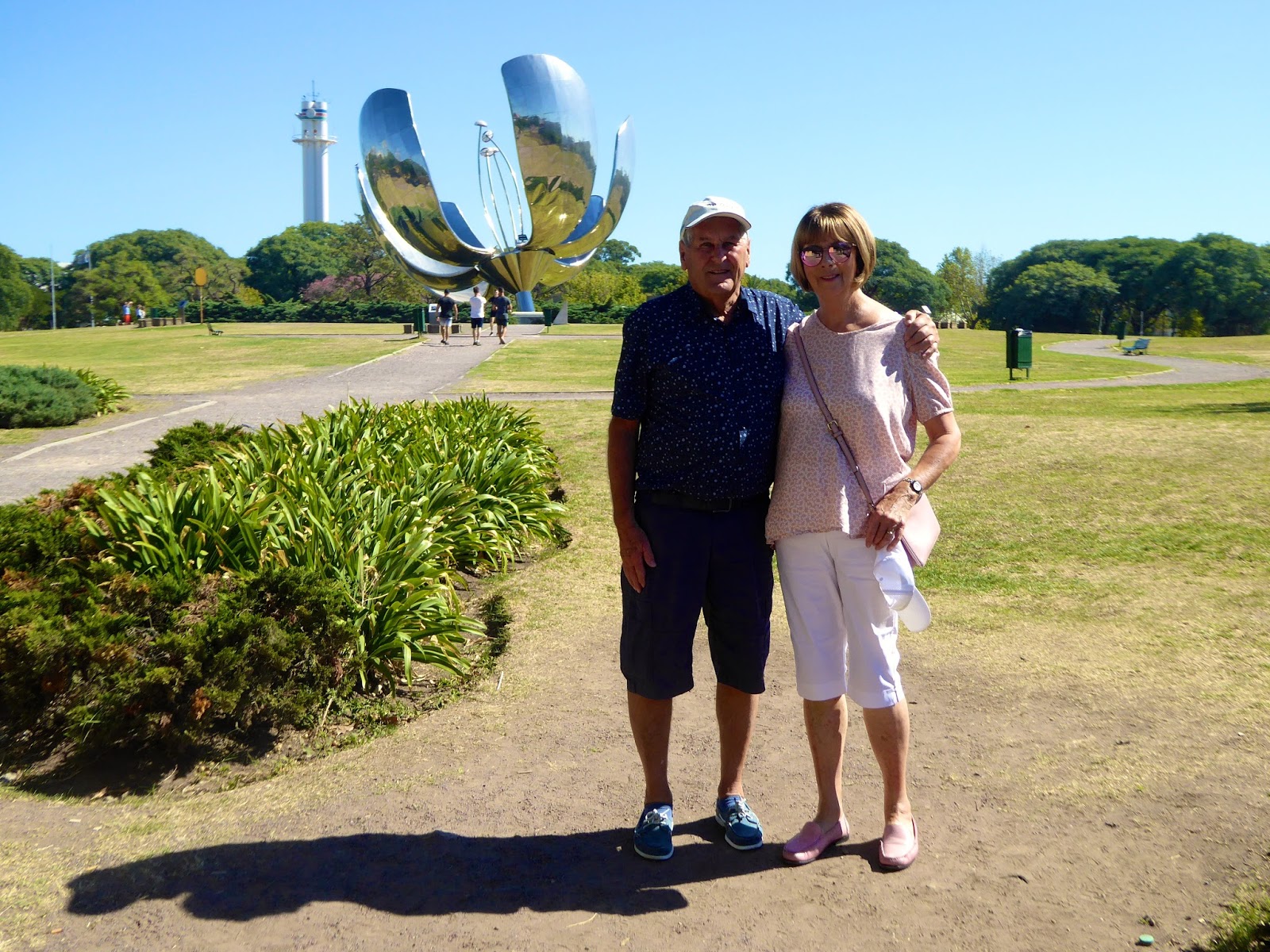
An impressive and stunning steel sculpture in one of the many city Parks. A flower 28 metres in height and 18 tons of weight. It has a complex and high technology system that makes the petals open with the first sunlight of the day until its complete shape is complete. It then closes again at sunset.
The city's Botanical Gardens are a triangular shape. The rose gardens were past their best but there were many unusual colours of purples and blues which were beautiful.
Being Sunday it was a very popular place for families.
Our visit to the La Recoleta cemetery was fantastic and is Buenos Aires top attraction. (entrance above ) Its a city of the dead where the 'streets' are lined with impressive statues and mausoleums. Past Presidents, military heroes, politicians and just plain rich people are buried here. The most notable being Eva Peron (Evita)
First we had to pass through security where the head cat wasn't interested in scrutinising anyone!!!
People today still leave flowers on her grave. She was a very popular first Lady of the city and founded The Eva Peron foundation set up for homeless women and children.
Subscribe to:
Posts (Atom)